I’m a builder and researcher working on how groups of people communicate, decide and act together when an AI sits between them.
Any group, whether a team, a town or a country, is made of people who see the world differently. They misread each other and talk past each other, and yet they sometimes work out something none of them could have worked out alone. I find that more interesting than any one person’s intelligence.
What a group can work out depends on what it draws out of its members and how that travels between them. Each person is a complicated black box of passing feelings, long-held convictions and things they could never put into words, and our meetings, votes and surveys reach only a sliver of it. With AI, I believe a town or even a country could come to know what its people actually think, in depth and all at once, and act on it together. It could also make room for kinds of groups that have never existed, ones that gather around a question and dissolve once it is answered.
But an AI that knows what people think can easily start speaking for them. The more it does on their behalf, the less of the result is theirs, and at the extreme they would hardly take part in their own group’s decisions. I want to push augmentation as far as it can go while keeping agency with the people themselves, and the tension between those two is the problem I most want to work on.
I work on it by building systems and running them in real places, from a citizens’ assembly of twenty residents to a national election campaign.
[One line about life outside work.]
Now
Sony Computer Science LaboratoriesResearch Assistant, Cybernetic Humanity Studio2024–
Plural RealityCo-founder2025–
Keio University Global Research InstituteResearcher, PRANCE2026–
Columbia UniversityComputer Science and Political Science
Before
Team MiraiFounding Engineer2024–2026
Digital Democracy 2030Product Owner, Idobata2024–2025
University of Tokyo, Naemura LabResearch Collaborator2024
Columbia CGUI LabResearch Assistant, with Steven Feiner2023–2024
Work
A manifesto voters could edit
Team Mirai2025 upper-house electionfounding engineer
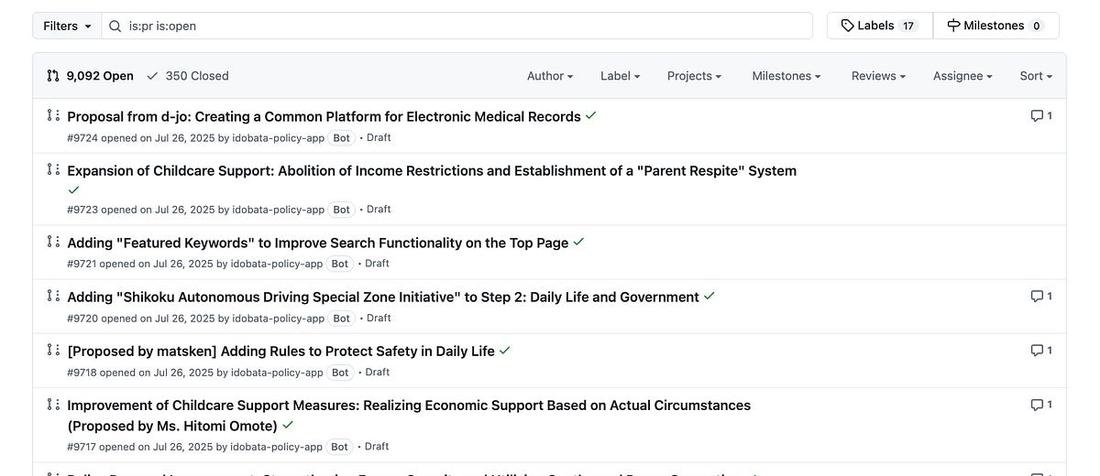
Proposals arriving as pull requests during the campaign.
Team Mirai, a party the AI engineer Takahiro Anno founded in 2025, keeps its manifesto on GitHub. During the 2025 upper-house campaign, anyone could open a chat beside the manifesto, talk a policy through with an AI, and turn what they said into a proposed edit. Each proposal became a public pull request for the party’s policy team to review. In seventeen days, 9,688 proposals came in and 346 were merged, among them public funding for HPV vaccination for men and support for children with disabilities who lose services at eighteen.
Most of the other proposals read like “lower taxes” or “better school lunches.” They showed which way people leaned, but nobody could negotiate with them, and that gap is what I have worked on since. I wrote about it in People Don’t Know What They Want.
Built with many contributors from Team Mirai and Digital Democracy 2030.
Baisoku Kaigi
Plural Reality150+ sessions with cities and companiesco-founder
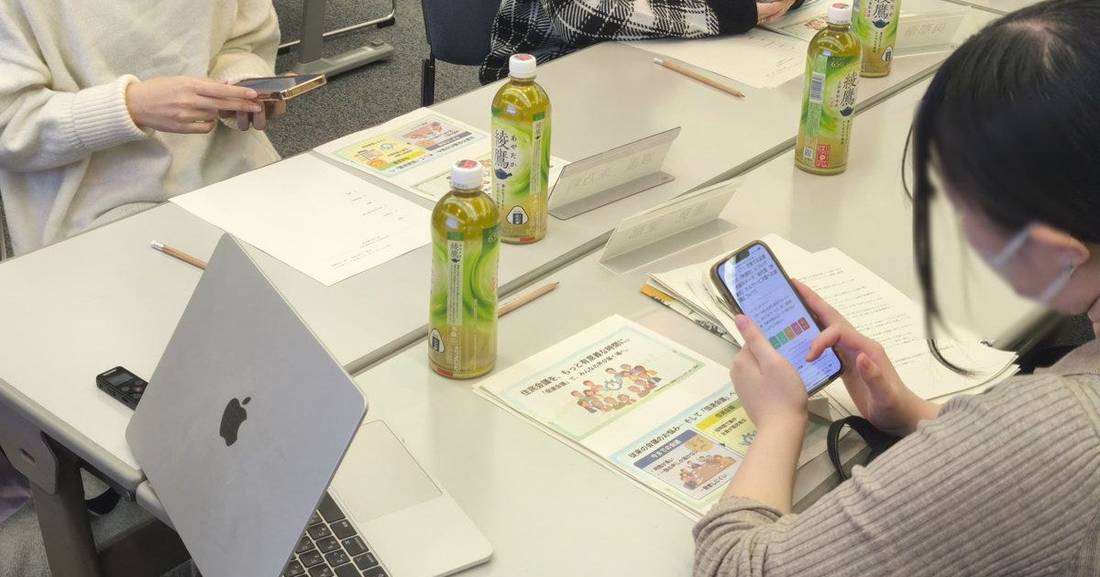
Residents answering the AI’s questions before the meeting starts.
Before a meeting starts, each participant answers about fifteen questions from an AI on their phone. Each question builds on the earlier answers, so people work out where they stand before they have to say it in front of others. When the meeting opens, the group sees one page showing where it already agrees, where it splits, and which splits are about facts and which are about values.
In Ota City, twenty randomly selected residents met to discuss childcare. The room was silent at first and opened up once that page was on the screen. Later, when a parent said school lunches had clearly gotten worse, the facilitator could ask whether that was a fact or an impression, because the page had already shown the group was divided on it. With support from Mozilla’s Democracy x AI cohort, we are now piloting the same process in Otoineppu, a village of about 600 people in Hokkaido whose council has trouble filling its seats.
AI clones of museum science communicators
Sony CSL × Miraikan457 conversations with visitorsCUI ’26 Best Paper
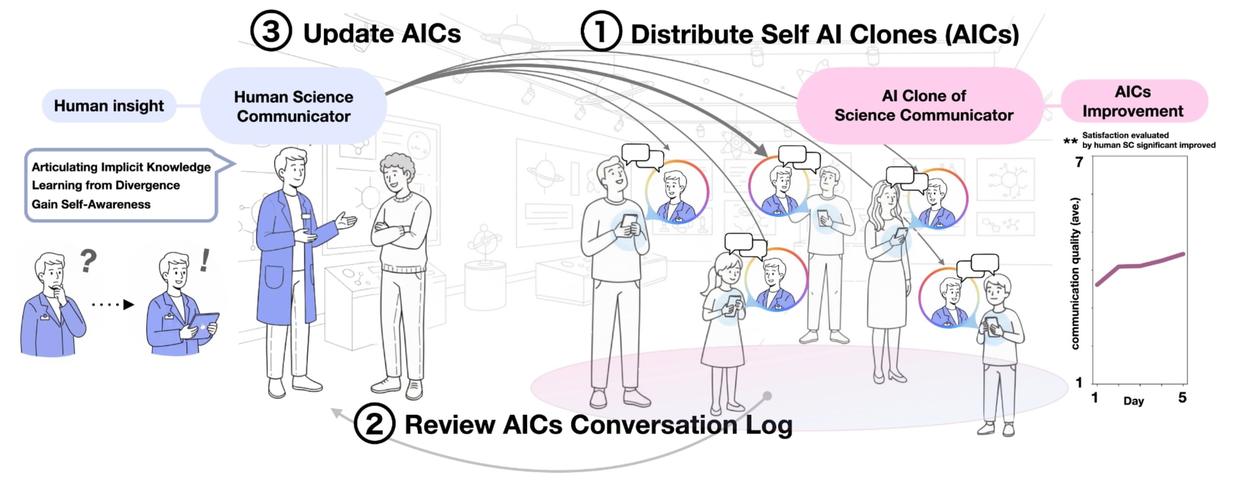
The loop between each communicator and their clones, from the CUI ’26 paper.
At Miraikan, Tokyo’s national science museum, we made voice clones of six professional science communicators and let visitors talk with them on the exhibition floor. Every day the communicators read their clones’ conversations, marked what sounded like them and what did not, and rewrote the description each clone works from.
Visitors’ ratings of the clones barely changed. The communicators changed more. They put into words habits they had never written down, and some used their clone to try out the communicator they wanted to become. The project later grew to nine communicators and received a 2026 Good Design Award.
A chat where each person reads a different conversation
with the University of Tokyo2024–25arXiv preprint
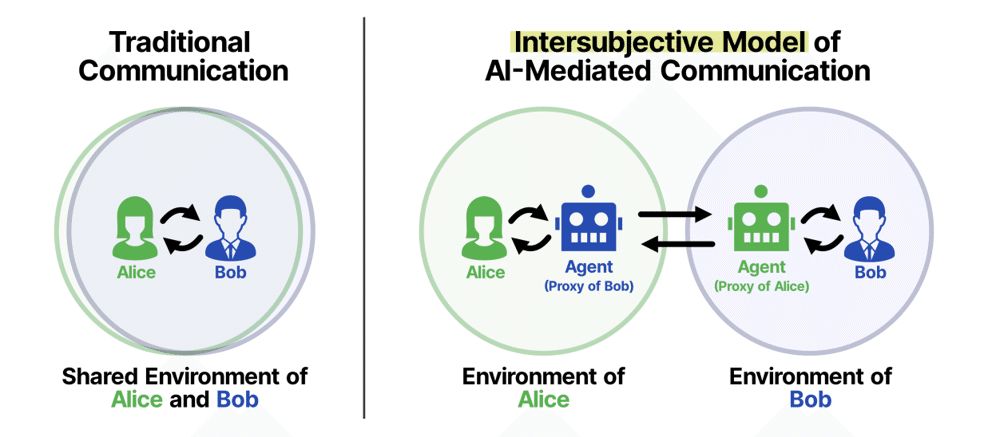
In the intersubjective model, each person talks through an agent that builds a separate environment for them.
An AI rewrites each message on the way, so I can be talking about coffee while you read about architecture. I built the first version in a few hours and posted it online, and VR developers, screenwriters and communication researchers started using it in ways I had not planned. It became a study with Rintaro Chujo, Ari Hautasaari and Takeshi Naemura of what two people still share when they no longer share the same words.
Earlier
Kineto2020–21 · IPA Mitou A video lecture platform where students watching at their own pace could still see each other’s notes, pinned to the moment in the video. Playback speed drifted between 0.9× and 1.2× to keep classmates close together without them noticing.
Robot assembly from VR2023–24 · Columbia CGUI Lab You arrange parts in VR, and a remote robot assembles them later in its own order. The VR scene and the real workspace are allowed to be out of sync.
CUI ’26Designing a Feedback Loop Between a Human and Their AI Clones for Science Communication in MuseumsShutaro Aoyama, Kiyoshi Suganuma, He Jiang, Shunichi KasaharaBest Paper Award
arXiv 2025Intersubjective Model of AI-mediated Communication: Augmenting Human-Human Text Chat through LLM-based Adaptive Agent PairShutaro Aoyama, Rintaro Chujo, Ari Hautasaari, Takeshi Naemura
IEEE VR ’24Asynchronously Assigning, Monitoring, and Managing Assembly Goals in Virtual Reality for High-Level Robot TeleoperationShutaro Aoyama, Jen-Shuo Liu, Portia Wang, Shreeya Jain, Xuezhen Wang, Jingxi Xu, Shuran Song, Barbara Tversky, Steven Feiner
[Link to the full CV (PDF) here.]
Bios you can copy
If you are introducing me at an event or in an article, feel free to use either of these as they are. They were last updated in November 2026.
Short
Shutaro Aoyama designs and studies AI-mediated systems that help groups of people communicate and work together. He is a research assistant at Sony Computer Science Laboratories and a co-founder of Plural Reality, and he was a founding engineer of Team Mirai, a Japanese political party. He studies computer science and political science at Columbia University.
Long
Shutaro Aoyama designs and studies AI-mediated systems that help groups of people communicate, decide and work together, especially when their members see the world differently. As a founding engineer of Team Mirai, a Japanese political party that won eleven seats in the 2026 general election, he helped build the system that turned voters’ conversations with an AI into proposed edits to the party’s manifesto; 346 of 9,688 proposals were adopted. He co-founded Plural Reality, whose pre-meeting AI interviews have been used in more than 150 sessions with cities and companies. At Sony Computer Science Laboratories, his work on AI clones of museum science communicators received the Best Paper Award at ACM CUI 2026. He studies computer science and political science at Columbia University.